(From PGC June Elk BULLetin Newsletter)
This is by far one of the most common questions we get: how many elk are in Pennsylvania? Keeping track of population trends and where elk are concentrated (distribution) helps guide management decisions related to habitat improvements, hunting licenses, and disease management.
Let’s get into the nitty gritty of how the PGC estimates the elk population. We must estimate the population; it’s impossible to count every single elk at any given moment in time so we use a combination of observations from the field as well as statistical calculations to produce an estimate with a margin of error (+/- so many animals). There are several methods of estimating wildlife populations; finding the best one depends on many different factors, such as how big an area you’re trying to cover, the size and behavior (nocturnal versus diurnal) of the animals you’re trying to count, reproductive cycles, the list goes on and on. For elk, we use an aerial survey combined with individually radio collared animals to calculate an overall estimate of the population. Each year during the mid-winter months (usually January and February), we partner with Owyhee Air Research to “survey” the elk population. They fly over a predesignated area (the area where our elk population lives), and using a sophisticated camera mounted to the belly of the plane, they count every elk they encounter along the way. The camera can “see” the infrared spectrum, meaning it can detect heat as well as the color spectrum you and I can see. The name of the game is to quickly pick out warm bodied animals against a colder landscape using thermal imaging, and then if needed, switch over to the high-definition color camera to see exactly what they’re looking at. All this video is recorded, and the position of the plane and where they’re looking on the ground is overlaid in the video. Add in the date and time, and we always know the location of the plane and, more importantly, whatever they are looking at, both in space and time. The result is a map showing how many elk were seen at a specific location at a certain date and time.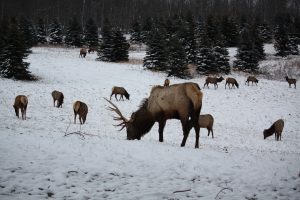
Obviously, flying over hundreds of thousands of acres with flight paths only separated by 500 meters is a colossal effort, but this is only half of the data needed to estimate the population. No matter how well the plane covers the survey area and how amazing the camera they use is, they’re still going to miss some elk. How do we account for this? In come the radio collared elk. If you’ve spent some time in elk country, you’ve likely seen an elk sporting a radio collar. These collars allow our biologists to track elk across the landscape at regular intervals (every 2-3 hours during the aerial survey), providing precise locations of where elk are spending time. By comparing the observations collected during the aerial survey with the locations of the radio collared elk, we can estimate what proportion of the elk population was seen and what was missed. The plane crew has no knowledge of where the collared elk are or how many there are. For example, let’s say we have 100 radio collared elk scattered across the entire elk range, and because we know where they are in space and time, we can just add these to the same map of all the elk observed during the aerial survey. If they match, that elk was seen by the plane; If they don’t, that elk was missed. If we have 65 matches of the 100 radio collared elk, we can deduce they missed about 35% of the overall population during the flight. This ratio of seen: missed (called the detection ratio) is basically used as a correction factor to the overall number of elk counted during the aerial survey. The formula is a little more complicated, but that’s the basic theory behind the scenes.
This year, our aerial survey began Jan. 21 and was finished by Feb. 10. The plane and crew traveled more than 11,000 miles and observed 74 different groups of elk. There were 106 radio collared elk during the survey and 68 (64%) were seen. The final estimate was 1,342 +/-150. Statistically speaking, the actual population is somewhere between 1,200-1,500 elk. This is similar to the previous year’s estimates and suggests the population is relatively stable overall. We conduct the aerial survey to estimate the population every year in January and February because the trees are leafless, elk are generally in larger, more concentrated groups in winter, and the landscape is colder which makes it easier to distinguish warm bodied elk.
Plan your elk viewing adventure at VisitPAGO.com