Cook Forest State Park, located in northwestern Pennsylvania along the Clarion River, encompasses more than 8,500 acres of protected lands—including over 6,000 acres of old‑growth forest. Its history is a compelling tale of conservation, family legacy, and civic action.
Early Inhabitants and Settlement
Long before European settlers arrived, the area served as hunting grounds for the Seneca Nation of the Iroquois Confederacy. In 1757, Moravian missionary Christian Frederick Post attempted to enlist the Seneca in the French and Indian War on behalf of the British, but they allied with the French instead following the war, the English claimed the land from the Iroquois.
In 1826, John Cook became the first permanent American settler. Acting as a surveyor for Pennsylvania, he assessed the potential for canals along the Clarion River. He purchased 765 acres at the mouth of Toms Run, built sawmills using waterpower, logged with oxen, and floated timber to Pittsburgh via log rafts. Cook lived there with his wife and ten children from 1828 onward.
The Cook Family Enterprises
John’s son, Anthony (also referred to as Andrew in some records), expanded the family’s industrial operations by building additional sawmills, a flour mill, a planing mill, a boat scaffold, residences, and a store. Around 1870, he constructed the Cook Homestead. After Anthony’s death in 1891, the A. Cook Sons Company carried on timber operations, transporting lumber via river and later rail until about 1910.
Conservation Efforts and Establishment of the Park
By the early 20th century, the remaining stands of virgin white pine and hemlock caught the attention of conservation advocates. Major Israel McCreight of DuBois played a pivotal role, visiting the majestic “Forest Cathedral” and declaring its preservation essential. He spearheaded support through the Pennsylvania Conservation Association beginning around 1910.
In 1923, the Cook Forest Association formed, raising funds to save the land. They generated $200,000, and in 1927, the state legislature agreed to allocate $450,000—pending the association’s fundraising success. By December 1928, Pennsylvania acquired approximately 6,055 acres from A. Cook Sons Company for around $640,000, making Cook Forest the first Pennsylvania state park created to preserve a natural landmark.
CCC Development and Historic Structures
In the wake of the Great Depression, the Civilian Conservation Corps arrived in 1933 and built CCC Camp SP‑2. Between 1933 and 1935, they constructed trails, gates, roads, a log cabin inn, and the Indian and River cabins made from salvaged American chestnut—structures later listed on the National Register of Historic Places.
Fire Tower and Landmark Designation
A fire tower was erected in 1929, rising 87.5 feet to aid in spotting forest fires. It served until 1966 and still stands today, the “box” on top is occasionally open for public tours by park staff. In 1966, the forest earned recognition as a National Natural Landmark—especially the “Forest Cathedral” of towering white pines and hemlocks.
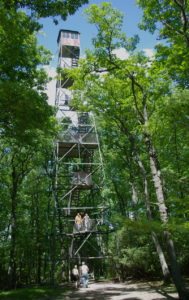
Photo credit: John Plate
Legacy and Continuing Conservation
Cook Forest remains one of the most significant tracts of old‑growth forest east of the Rocky Mountains, featuring majestic white pines, eastern hemlocks, and northern hardwoods. Cook Forest State Park stands as a living testament to early American settlement, family enterprise, and one of the nation’s earliest conservation victories. What began as a Cook family homestead evolved into Pennsylvania’s first natural preservation State Park. The park today is a cherished sanctuary where visitors can connect with centuries-old trees and explore the Wild & Scenic Clarion River.
Plan your adventure in Cook Forest State Park at VisitPAGO.com.