By Bob Imhof
 The history of Hallton, Elk County, PA is full of industries related to the lumbering business that was so prevalent beginning in the middle 1800’s. Among the industries that developed in Hallton was the Clawson Chemical Company founded on January 28, 1902 by Frank Edwin Clawson (1861-1927) to process pulpwood, chemical wood and charcoal. Mr. Clawson built a beautiful home at 522 Hyde Avenue in 1907 in Ridgway. The site at Hallton was one of four operated by Mr. Clawson, the others were located at Gilson (Barnes), Glen Hazel and Straight.
The plant at Hallton operated for many years receiving wood brought in on the Tionesta Valley Railroad from warrants that had been previously cut by the Central Pennsylvania Lumber Company. Somewhere around 1925 Frank Clawson began to fall behind in his wood payments to the Central Pennsylvania Lumber Company. In order to work on this financial difficulty, Mr. Clawson gave the CPL company stock as collateral. The financial situation did not improve and the CPL took over ownership of the company and Vice-President Sislee convinced Richard A. Cartwright of Ridgway to take over the operation, he agreed and purchased he Hallton and Gilson (Barnes) plants in 1926 or 1927. The Glen Hazel plant had been closed in 1919.
In order to increase the capacity at the Hallton plant, in 1932 Mr. Cartwright purchased half of the acetic acid plant formerly used by the Quinn’s at Glenfield, New York and this was the major reason that the Hallton plant operated longer than the Gilson(Barnes) plant. By 1935 the Central Pennsylvania Lumber Company had just about completed their lumbering railroad operations supporting the huge hardwood mill in Sheffield and could find no reason for supporting a chemical plant they did not own so they sold the section of the Tionesta Valley Railroad from Sheffield Junction to Hallton (17 Miles) and the Clarion River Railway to Mr. Cartwright. The life of these two railroads were dependent on the Clawson Chemical Company and in 1941 Richard A. Cartwright died and ownership passed to his son Robert M. Cartwright. Business had been falling for a few years, but World War II gave the company a temporary boost and one section of the company that remained profitable was the acetic acid plant. The Susquehanna Chemical Company was formed in 1946 to consolidate the plants at Custer City, Westline, Sergeant and Hallton after Mr. Cartwright agreed to a 40% cash and 60% stock transaction after which he found a purchaser for his Susquehanna stock. 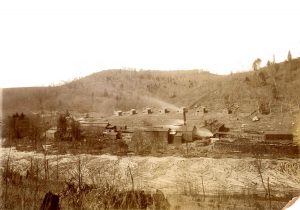
The Susquehanna Chemical Company operated the Hallton plant for two years when it was closed due to a strike in 1948. The plant was raised shortly after closing and if you wish to see remnants of the brick structure travel to Hallton and turn right on Factory Road and go the flats area next to Spring Creek and look for the splash dam base in the stream and just below that structure is a large brick debris field where the building was pushed into the stream.
Find more interesting place to visit and explore at VisitPAGO.com.